vae.py
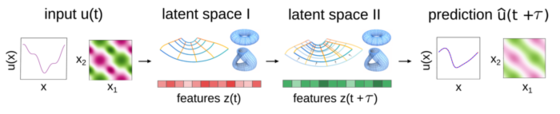
Variational Autoencoders (VAEs) for training neural networks and other models for learning latent structures from datasets based on Bayesian inference and variational approximations.
If you find these codes or methods helpful for your project, please cite our related work.
- vae.dyvae_loss(encoder_mean, encoder_log_variance, decoder_mean, latent_map, latent_map_params, input, target, **params)
Evaluates the VAE loss function based on ELBO estimator of the negative log probabiliy of the data set X, along with reconstruction and other regularizations for predicting dynamics (see paper). Uses MSE and KL divergence for reconstruction and prediction losses.
- Parameters:
encoder_mean (torch.nn.Module) – the model for the mean encoding for the input.
encoder_log_variance (torch.nn.Module) – the variance to use for encoding noise regularization.
decoder_mean (torch.nn.Module) – the model for the mean decoding for the output.
latent_map (torch.nn.Module) – the latent space mapping.
latent_map_params (torch.nn.Module) – the latent space mapping parameters.
input (Tensor) – x input to the GD-VAE.
target (Tensor) – X target output expected from VAE for loss.
params (dict) – additional parameters (see examples and codes).
- Returns:
loss (Tensor) – loss evaluation comparing VAE output and target.
extra_params [members]
Property
Description
num_monte_carlo_samples
number of samples to use in MC estimators
latent_prior_std_dev
standard deviation for the latent space prior
gamma
strength of the reconstruction term
beta
Kullback-Leibler weight term as in \(\beta\)-VAEs
device
cpu, gpu, or other device to use
mse_loss
Mean-Squared-Error (mse) loss of torch.nn
- vae.eval_tilde_L_B(theta, phi, X_batch, **extra_params)
Evaluates the VAE loss function based on ELBO and the introduced regularization terms.
- Parameters:
theta (model) – model data structure for encoder.
phi (model) – model data structure for the decoder.
X_batch (Tensor) – collection of training data with which to compare the model results.
extra_params (dict) – additional parameters (see examples and codes).
- Returns:
loss (Tensor) – loss evaluation for \(\mathcal{L}_B\) (see paper for details).
extra_params [members]
Property
Description
m1_mc
number of samples to use in MC estimators
batch_size
size of training batch
total_N_xi
total number of x_i’s
num_dim_x
number of dimensions for x
num_dim_z
number of dimensions for z
device
cpu, gpu, or other device to use
beta
Kullback-Leibler weight term as in \(\beta\)-VAEs
- vae.get_statistic_ELBO(theta, phi, X_batch, **extra_params)
Returns the Evidence Lower Bound (ELBO) for models. The \(ELBO = -\mathcal{L}_B\).
- vae.get_statistic_KL(theta, phi, X_batch, **extra_params)
Compute estimate of the Kullback-Leibler divergence \(D_KL(q(z|x) | p(z)) = E_q[log(q(z|x))] - E_q[log(p(z))]\)
- vae.get_statistic_LL(theta, phi, X_batch, **extra_params)
We use importance sampling to estimate the Log Likelihood. Discussion in Burda, 2016, paper on importance weighted AE.
\(LL = \log\left(p(\mathbf{x})\right)\approx\log\left(\frac{1}{m}\sum_{j = 1}^m \frac{\tilde{p}_{\theta_e,\theta_d}(\mathbf{x},\mathbf{z}^{(j)})}{\mathfrak{q}_{\theta_e}(\mathbf{z}^{(j)} | \mathbf{x})}\right).\)
The samples are taken \(\mathbf{z}^{(j)} \sim \mathfrak{q}_{\theta_e}(\mathbf{z}^{(j)} | \mathbf{x})\). Here the joint-probability under the VAE model is given by \(\tilde{p}_{\theta_e,\theta_d}(\mathbf{x},\mathbf{z}) = \mathfrak{p}_{\theta_d}(\mathbf{x} | \mathbf{z}) \mathfrak{p}_{\theta_d}(\mathbf{z}).\)
- Parameters:
theta (dict) – decoder model
phi (dict) – encoder model
X_batch (Tensor) – input points. Tensor of shape = [num_x,num_dim_x].
extra_params (dict) – extra parameters (see examples and codes).
- Returns:
LL (double) – statistic LL.
- vae.get_statistic_RE(theta, phi, X_batch, **extra_params)
Compute estimate of the reconstruction error term \(RE = E_q[log(p(x|z))] - E_q[log(p(z))]\)
- vae.loss_VAE_neg_tilde_L_B(X_batch, theta, phi, **extra_params)
Evaluates the VAE loss function based on ELBO estimator of the negative log probabiliy of the data set X, loss = \(-\tilde{\mathcal{L}}_B\)
- Parameters:
X_batch (Tensor) – collection of training samples.
theta (model) – model data structure for encoder.
phi (model) – model data structure for the decoder.
extra_params (dict) – additional parameters (see examples and codes).
- Returns:
loss (Tensor) – loss evaluation for \(-\mathcal{L}_B\).
extra_params [members]
Property
Description
m1_mc
number of samples to use in MC estimators
batch_size
size of training batch
total_N_xi
total number of x_i’s
num_dim_x
number of dimensions for x
num_dim_z
number of dimensions for z
device
cpu, gpu, or other device to use
beta
Kullback-Leibler weight term as in \(\beta\)-VAEs
- vae.loss_relative(predicted, target)
L1-relative loss from element-wise differences between tensors.